



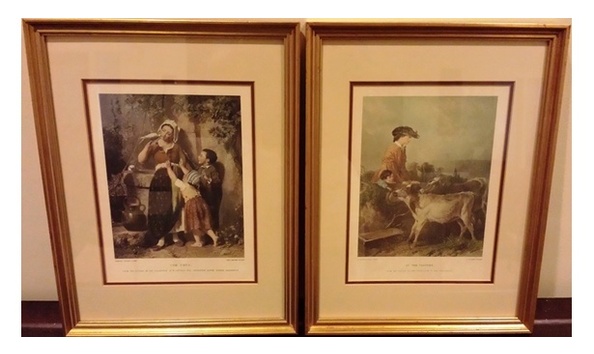
Two Victorian-era Framed Lithograph Prints!
These two beautifully framed antique vertical lithographs in the frames measure 13-inches wide by 17-inches tall.
"Our Pets"
by Pierre Jean Edmond Castan (1817-1865)
A vintage framed behind glass lithograph depicting a French girl playing with a dove pet at a water well. The gold double mat frame and UV-resistant glass is of archival quality.
According to the British Museum, this particular work was done by Castan in 1886. Castan was French. Born in Toulouse in Haute-Garonne, Edmond Castan quickly turns to the drawing, and follows the teaching of Drolling in Paris. He is then a pupil of Gérard, and begins in the Salon of French Artists in 1868.
During the 1870-1880’s, he realizes especially scenes of genre. He mostly represents simple moments of the daily life, in peasant inside, or children's games which confer to his works a particular freshness.
Later, he also sends portraits to the Salon, in particular in 1875, and from 1878 to 1880.
His very fine technique and the multitude of details which he brings to his compositions are noticed by french amateurs as well as foreign’s.
"Our Pets; a woman holding a bird on her finger, standing in front of a well at the edge of a building with a vine growing up the side, while two children beside her reach upwards towards the bird..."
Castan was a famous painter and engraver of his time. This particular print was done in 1888.
"In The Pasture" by Richard Ansdell (1815-1885).
This vintage framed behind glass lithograph depicts a mother and a child with cows. The Victorian-era print has a gold double mat frame.
Ansdell was an English oil painter and engraver. He was most well known for animals and genre scenes. A Gold Medal winner at the famous Paris Exhibition, Ansdell was a foremost artist.
Richard Ansdell was elected Associate of the Royal Academy in 1861 and Royal Academician in 1870. He became one of the most successful Victorian sporting artists, collaborating on huge canvases with artists such as Thomas Creswick (1811 – 1869) and William Powell Frith (1819 – 1909) placing the animals into their landscapes.
In 1861 Ansdell produced one of his masterpieces “The Hunted Slaves” – a very effective and popular piece of melodrama (after a Longfellow poem – “The Dismal Swamp”) with an anti slave trade message. Now in the International Slavery Museum.
After he had discovered Scotland and had built his own Lodge there on the banks of Loch Laggan, he spent time north of the border whenever he could – painting many Scottish subjects – stags in glens, sheep on hillsides, moorland/mountain scenes, sheep-dipping, everyday scenes in a shepherd’s life, shooting parties.
Many of his paintings were engraved for reproduction and sale on the mass market thus producing valuable income to the artist and ensuring publicity both in the United Kingdom and also in America.
Another fellow artist, John Philip (1817 – 1867) known for his battle and historical scenes, inspired Ansdell to produce a few paintings in the same genre “The Death of Sir William Lambton at the Battle of Waterloo” (Harris Museum, Preston), being one of them. In 1856 Philip and Ansdell travelled to Spain and collaborated on many Spanish pictures – Ansdell travelled to Spain again on his own the following year, producing many paintings with a Spanish theme: “Feeding Goats in the Alhambra” being one such painting. (Also in the Harris Museum)
Ansdell was extremely prolific and hitherto unknown paintings are always coming to light; having been undocumented in family collections since Victorian times. He painted a wide variety of sporting, animal and romantic narrative subjects, and was especially noted for his depiction of many breeds of dogs – executed in fine, realistic detail with a sound knowledge of the subject.
This particular lithographic print was done as a 19th Century steel engraving. It was made in 1883.
Name : Frederick Burton
 What is CharityAuctionsToday?