


The Horsehead Nebula in Orion & Andromeda Galaxy - Laminate Prints
- 11inx17
- 2 Prints in Total
The first image is the constellation of Orion. The constellation of Orion is very popular and easily recognizable since it dominates the winter sky. The constellation rises in the southeast. If you are not familiar with the constellation, you will be surprised at how much sky the constellation fills.
In Greek mythology, Orion is known as the Great Hunter. The upper right shoulder of Orion is the bright Red Supergiant. It is the tenth brightest star that we can observe.
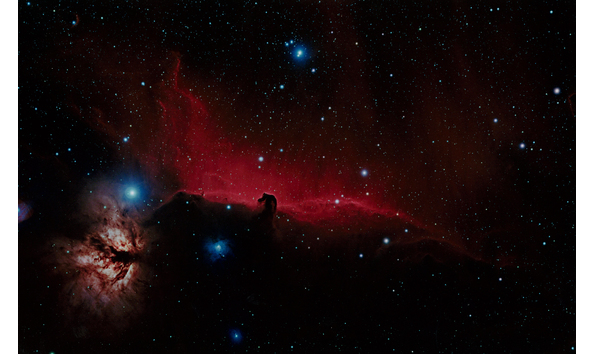
Two significant features in the constellation are the three stars that make up Orion's belt and the star pattern directly below the belt is called Orion's sword. There are several interesting nebulae that can be photographed in this region of the sky. One of these objects is the Horsehead Nebula along with the Flame Nebula. Another is the Great Nebula in Orion or M42.
At the center of this photo is the Horsehead Nebula. This region of the sky is part of a molecular cloud complex where stars are being formed.
The data to create this image was taken in December of 2020 at my backyard observatory in Grand Junction. A retractor with a 6" objective lens was used. The total amount of integrated exposure time is about 2.5 hours.
The bright blue star just to the left of the horsehead is called Alnitak. The star is appropriately named from the Arabic word for belt since Alnitak is the leftmost star in Orion's belt. The Horsehead itself is caused by dust that is absorbing the light from the region behind it. The distance to the nebula is around 1,375 light years.
The nebulosity just below Alnitak is called the Flame Nebula. This is an emission nebula meaning that it emits its own light. Once again, the interesting pattern that we see is due to light from the nebula being absorbed by materials that are in the foreground.
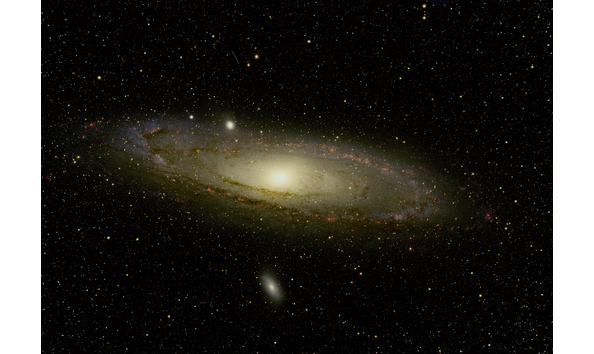
The second image is an image of the familiar Andromeda Galaxy (M31). If you can find an area where the nighttime skies are dark enough to see the Milky Way, you can see this galaxy as the ancients did, as a small diffuse source of light. For many years, astronomers believed that this galaxy was a gaseous nebula. In 1923 Edwin Hubble took images of the galaxy with the 100-inch reflector telescope at Mount Wilson Observatory in the hills north of Los Angeles. He proved that the object was outside of our galaxy by determining the magnitude of the light coming from Cepheid variable stars found in his astrophotos.
The stars seen in this photo are part of our galaxy, The Milky Way. So, they are actually in the foreground. There are two smaller or dwarf galaxies in the image: M110 in the lower center part of the photo and M32 seen as a bright object on a line of sight on the outer spiral of the Andromeda Galaxy. The "M" designation for these objects comes from a French astronomer, Charles Messier, who published a catalog in 1781 that listed over 100 astronomical objects.
The image has captured dark brown regions, or dust lanes, that follow the contours of the galactic spiral arms. The red regions are high concentrations of hydrogen gas where stars are being formed. The diffuse blue light represents an ion gas cloud that surrounds the galaxy. The photo is an accumulation of 11.3 hours of exposures using five different optical filters. I used a 4" retractor telescope that is attached to a precision telescope mount that tracks celestial objects with high accuracy compensating for the rotation of the earth. The final component of the imaging train is a special monochromatic camera that is "cooled" to reduce electronic noise that can build up over long exposures. The data was taken in my "backyard observatory" over a span of three different nights. Following data acquisition is image processing. Over 90 subframes were stacked and registered with color adjustments to ultimately achieve a piece of art. There is scientific information here, however, there is a great deal of subjective input during the process.
It takes around seven minutes for the sun's light to travel from the sun to the earth. It takes 2.5 million light years for Andromeda's light to reach us. One of the interesting facts about early 20th century astronomy is the underestimation of astronomical distances. This issue was resolved by Henrietta Swan Leavitt, who worked at the Harvard College Observatory in the early 1900's. She discovered the relationship between luminosity and the pulsation period of Cepheid variable stars. There is a very interesting book that tells this whole story. I recommend you read the The Glass Universe by Dava Sobel. -Submitted by Frank Wilkinson Ill

Company Name : CGA Board of Directors
Name : Frank Wilkinson
 What is CharityAuctionsToday?