


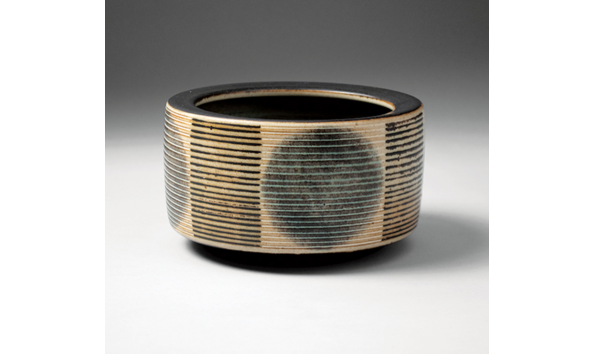

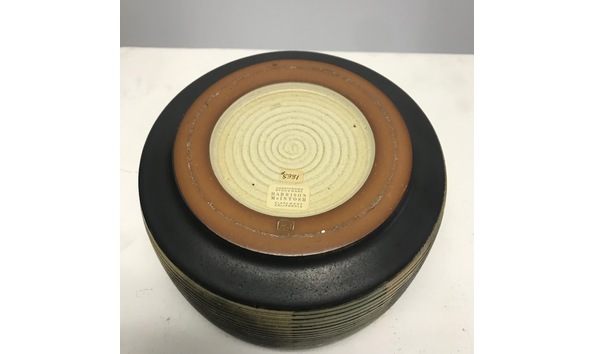
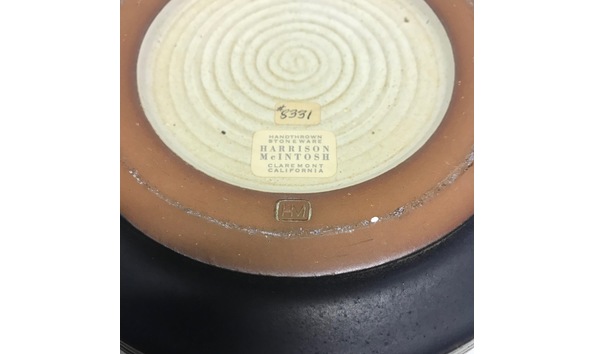
HARRISON McINTOSH - Bowl, 1975, stoneware, glaze, 4 x 7 in. dia.
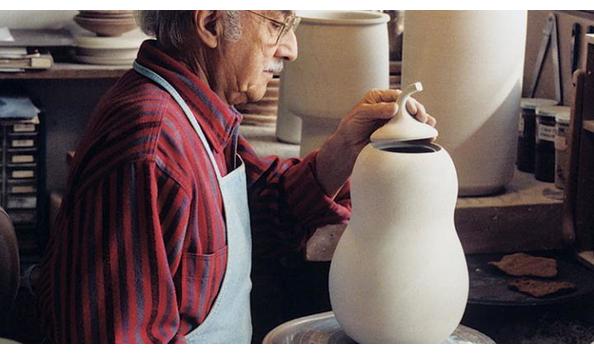
HARRISON McINTOSH (1914 - 2016)
For your consideration! A beautiful Harrison McIntosh, Bowl, 1975, stoneware, glaze, 4 x 7 in. dia. from a local estate.
McIntosh was born in Vallejo, California, on September 11, 1914, and raised in nearby Stockton. Alongside his brother, Robert, he experimented with painting throughout his youth, mentored by local landscape artist Arthur Haddock. It wasn’t until the McIntosh family relocated to Los Angeles in 1937, following Robert’s acceptance into the Art Center School (now the Art Center College of Design), that McIntosh discovered his passion for three-dimensional objects. In Los Angeles, McIntosh acquired carving and molding skills while crafting hand-built frames at an art supply store. He also helped architect Richard Neutra in the construction of his parents’ home – a wise move, because not only did he learn about design, but also he could push for incorporating an art studio into the garage.
After a galvanizing visit to the Japanese ceramics and folk art pavilion at the 1939 San Francisco World’s Fair, McIntosh used his new workspace to create his earliest works in clay. “In the garage I made a torso about 2 feet high and had it fired at a place called the Italian Terra Cotta Company, where they fired works up to 8 feet tall in very large kilns,” McIntosh recalled in a 2014 American Craft interview.
This and other early pieces were displayed at his first exhibition at the exclusive Bullock’s Wilshire department store in downtown Los Angeles. During this time, McIntosh also took night classes at the University of Southern California, studying under pioneering ceramist Glen Lukens. Through these early experiences, he became good friends with potters Otto and Gertrud Natzler, whose works were also exhibited at Bullock’s.
The Lukens and the Natzlers were the first of many influential midcentury ceramists McIntosh would encounter and befriend in the subsequent decades. When McIntosh returned from serving as a medic in World War II, he used the GI Bill to study ceramics at Scripps College. While studying at Scripps, McIntosh met his future wife, Marguerite Loyau, a Fulbright fellow from France who taught French at nearby Pomona College while both were enrolled in a ceramics class taught by Richard Petterson. The McIntoshes were married in 1952 and their daughter, Catherine, was born two years later.
During this time, McIntosh also learned about porcelain and the business of ceramics as an employee of Albert King, experienced the joy of spontaneous handthrowing in a workshop with Marguerite Wildenhain, took a seminar taught by legendary potter Bernard Leach, and met Shoji Hamada on his famous United States tour.
The McIntoshes settled in Claremont, where Harrison set up a longtime studio with his friend Rupert Deese. Marguerite, who taught French at colleges in the area, became her husband's business partner and worked with him on commercial design projects in Japan and Germany. She also provided assistance with many exhibitions, including a major 2009 retrospective, "A Timeless Legacy," at the American Museum of Ceramic Art in Pomona.
While these experiences, along with his friendships with Peter Voulkos, Paul Soldner, and Deese, certainly influenced McIntosh, his work remained steadfastly his own throughout his career. His cosmic-inspired vessels and sculptures exude a strong sense of balance. “I think most people love Harrison’s work because the way he treats the surface and decoration inspires a sense of absolute peace, strength, and harmony,” McIntosh’s wife, muse, and critic of 62 years told American Craft.
Today, McIntosh’s work can be found in private and museum collections around the globe, including the Louvre's Musée des Arts Decoratifs in Paris, the Smithsonian Institution's Renwick Gallery in Washington, Boston's Museum of Fine Arts, and the Los Angeles County Museum of Art.
 What is CharityAuctionsToday?